Showing posts with label Saigon. Show all posts

Friday, December 2, 2016

Ho Chi Min City Tour, Vietnam (Friday, November 11th, 2016)

As we rode the bus back to Saigon from the Cu Chi tunnels, we watched one of the anti-American propaganda videos from the war era. It was apparently produced by the Viet Cong to recruit more communist forces during the war. It was very interesting to listen to, in a twisted kind of way.

I really enjoy the bus rides and wish there were more of them on this trip.  It gives us a chance to see the countryside and see how the people in the area live, but it also gives our tour guide time to provide us with so much helpful information!  One of the people in our group told him that he talks to much, but I definitely disagree. If I've come this far, I want to know all there is to know!  Part of the reason we came on this trip was to learn and man are we learning.   Sometimes what we are learning is very difficult to hear given the topic but that just part of the experience!

To give you an idea about why we travel by plane, Khanh told us that to travel 200 miles by bus would take about 8 hours, and a flight is under an hour.

As we re-entered the city, the traffic once again picked up and reminded us about all of our new rules in the big city they now call Ho Chi Min.


And then we catch a glimpse of something else that once again takes us back in time.  The amazing thing is, it all co-exists right here in this beautiful city.


When we got back to the hotel, it was lunch time, so we decided to head across the street to a little restaurant called Mon Hue that the concierge recommended.  

Like most menus in the touristy areas, they had pictures of the dishes and a small English description, which makes ordering so much easier.  


58,000 Vietnamese dong is approximately $2.50 in US dollars! 
We both ordered number 9, which we thought was going to be a soup, but when it came, it was more of a salad.  It had a wonderful dressing on it, so we gobbled it down and weren't disappointed at all.  It just wasn't what we expected.  That's part of the adventure of traveling!


The restaurant had a very nice atmosphere, but like most restaurants in Cambodia and Vietnam, it is only about 12 feet wide. So the bar and the cashier were on the first floor with the customers and the kitchen was on the second floor.  Every dish had to be carried from the second floor down to be served, and all of the dirty dishes had to be carried back up to be washed.


After lunch we all met up at the hotel for an afternoon tour of the city.  We enjoy the city tours because they point out a lot of the main attractions, but even more than that, it helps us to get our bearings before we venture out on our own to see the things we want to see.

As we rode along in the bus, Papa Khanh gave us some interesting facts about Vietnam, and we also made some interesting observations.


-School for kids is 1/2 day. They go either in the morning 7-11 or afternoon 1-5.  There are a lot of kids that work as street vendors in the afternoon.  We had a chance to talk to some of them, and they go to school in the morning and then help make money for their families in the afternoon.  Most of them speak very good English and are a pleasure to talk to.

-It's the law in Vietnam that if you are in their country you have to use their currency. 

-On large streets, cars and buses stay to the left and motorbikes stay to the right. On small streets it's a free for all!

-Vietnamese language uses the Roman alphabet, so the letters are easy for Americans to decipher compared to the Cambodian alphabet.

-The pollution in Ho Chi Minh City is bad!

-Many Cambodian and Vietnamese people cover every square inch of their bodies and faces when they are outside to keep their skin white.

-Restaurant tipping in Cambodia is 10%, and in Vietnam is 5%.

The Mitexco building in central Siagon is the second tallest building in Vietnam. On the 52nd floor there is a coffee shop where you can enjoy views of the city, but if you go to the 52nd floor, but must purchase at least a beverage.


The Hotel Continental Siagon is the oldest hotel in Saigon.


We also saw the Siagon Opera House


The Carravel Siagon is where the high ranking American officials stayed during the Vietnam war.


They are building a new subway in Saigon.


The Rex Hotel is where the 5:00 bomb exploded.


The yellow building with red flag is city hall.  It was the parliament building during the war.


The little gray building, literally dwarfed by the newer taller buildings, was the head of the CIA during the war.  It is where the helicopters evacuated dignitaries and soldiers at the end of the war, and was in the movie "Last Days in Vietnam", Rory Kennedy's eye opening documentary about the 1975 evacuation of the American Embassy in Saigon.  It is sobering to see these real relics of such a volatile time in world history.


We visited the post office with its French style architecture, built in the mid 19th century.  It was made to look like a train station, but was never used as one.  


Even the inside of the building looks like a train station, but to this day, it is a functioning post office.


When we came out of the post office, there was a group of school kids on a field trip.  One of the bolder girls asked me if I would mind taking a picture with her, so of course I said I would love to. The entire class stood and watched in awe as we took our picture, so when we were done, I asked if anyone else wanted a picture, and the entire class came running.  These kids are so polite and would have never inconvenienced me for another picture, so I was really glad that I asked them before we continued on.

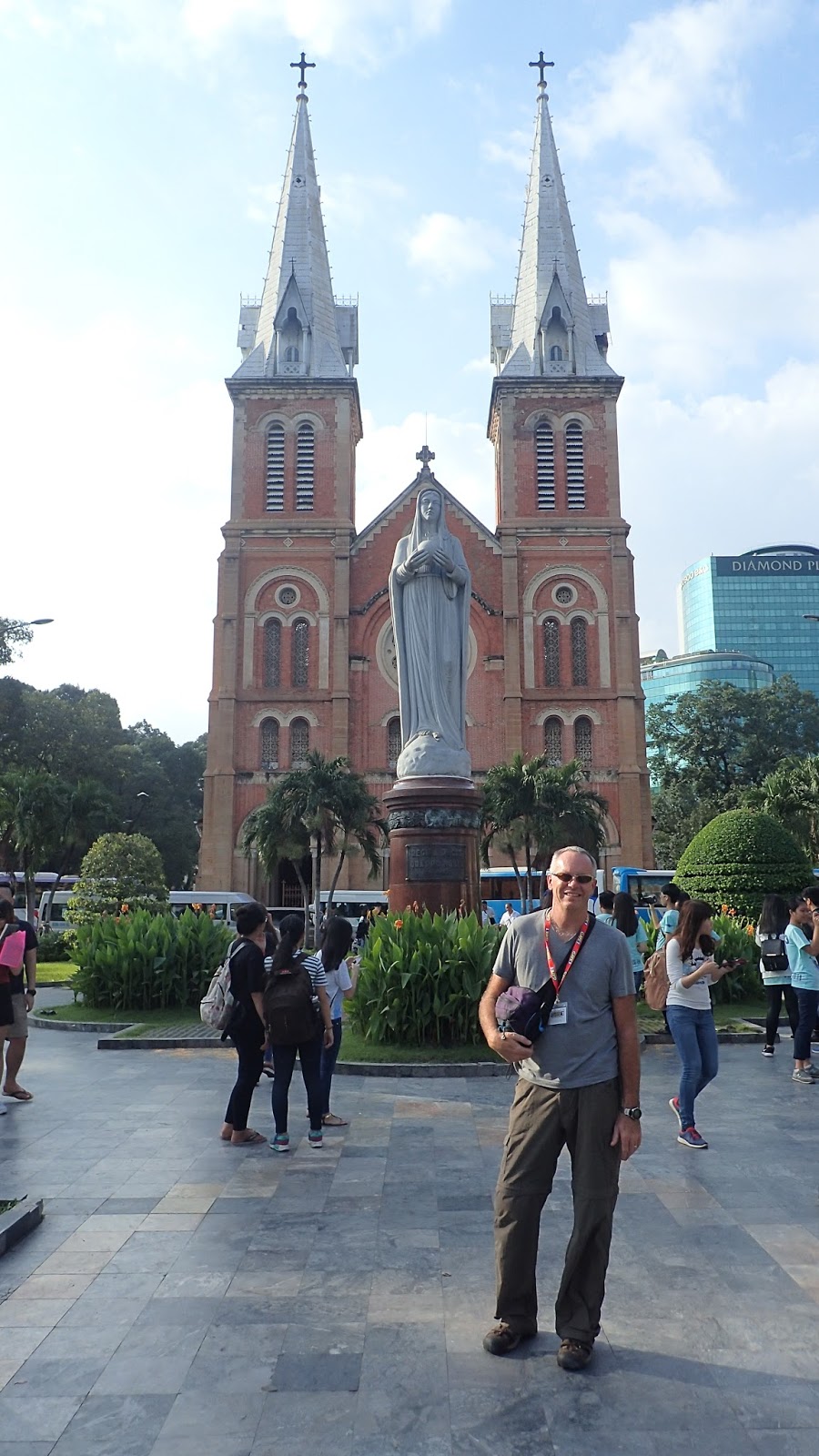
Right across the street from the post office is the Notre Dame Cathedral.  It is a beautiful building, built from 1877 to 1880.  It is fun to see the distinct differences in building styles between the Hindu's, the Buddhist's and the Catholics here in Vietnam.  They are all so grand and beautiful, but in very different ways.


A view of the Notre Dame Cathedral from the back.
Next, we jumped back in the bus to finish our tour.  We stopped at a lacquer workshop where we learned how lacquer wares are made. 


We then had a chance to shop in their store.  It's always fun to see what everyone buys at each of the locations.

I fell in love with this lacquer picture.  It has egg shells embedded in the lacquer to give it the crackly effect.

The building below was built by the French and was originally the Governors palace.  When south Vietnam became it's own country after the Geneva treaty, it became the South Vietnamese Presidential Palace.  The final act of the Vietnam war was on April 30th, 1975 at 11:30 am, when a North Vietnamese Army tank drove through the gates of this palace and took control.  That act ended the war, and Vietnam became one.


Our final stop on our city tour was the Ben Thanh Market, where an unbelievable assortment of wares are sold under one roof.


This bumpy fruit is called custard apple.  Chris and Helen bought us some to try.  They are very creamy tasting and good, but Steve had a mild allergic reaction when he tried it, so no more custard apples for him!  Darn!

When the merchant's pack up their stands for the night, they put all of their merchandise into these numbered bags where it is locked up until the next day when they will take it all back out and start again.


We have a fun view of the city from our room at the Liberty Central Saigon, including a view of the traffic below.  I have to admit that I am mesmerized by watching the traffic.

The thing I've enjoyed the most is watching this little balcony right below us.  I know that kind of makes me look like a stalker, but I'm really not.  It's hard not to notice this balcony because it is "Right There" outside of our window. 

I'm pretty sure that the woman who lives here runs a laundry service.  There is always a lot of laundry hanging out on this balcony, and each time I look out, it's always different laundry.


Our fellow traveler today (Chris) showed us how to use Google Maps with a phone or Ipod even if you don't have cellular or an active wifi connection. This is a really helpful feature when you are in a new city and don't want to get lost.  You can download a section of a Google Map that you can then use without cellular data or wifi. 

To get Google Maps to work without cellular, open google maps, hit the compass icon and it will download the map of where you are onto your device. Then drop a pin at your hotel, and as you move around the city google maps will track where you are using GPS. You can always find your way back to your hotel as long as your phone/Ipod is working even if you don't have cellular data or a wifi connection.  Thank you Chris!

Ho Chi Min City, Vietnam - Cu Chi Tunnels (Friday, November 11th, 2016)

Our tour guide, Khanh, is from Ho Chi Min City, so he knows a lot about this area.  Many people in Ho Chi Min still prefer to call it Saigon.

Before we were allowed to roam free in Ho Chi Min City, we were given some good advice from our tour guide.

Beware of taxi's in Ho Chi Min, they will rip you off!  Before getting into a taxi, always take a picture of the front and side of the taxi, and make sure the driver sees you do it.  If they know you are vigilant, they won't try to rip you off, and if you forget anything in the taxi, it can be tracked down for you.

Be careful crossing the street!  There are over 10 million people in Ho Chi Min City, and over 6 million motorbikes.  You have to be careful crossing the street.  Never run across a street, if you do, the motorbikes can't predict your actions and they will hit you.  Look for a small break in the traffic, then walk slow and steady.  The motorbikes and cars will drive around you.  In reality, we think drive is too calm of a word.  We think that they swerved around us! It is crazy but does work!

Never drink the tap water in Vietnam!  This was true in Cambodia too.  If you have to drink it, boil it first.  There is a boiler provided in every hotel room.

Watch out for bag snatchers!  If your bag has a strap, always use it and keep your bag close to your body.

Our tour guide reminded us that this is a very safe city, but like all large cities, there is poverty, and where there's poverty, there are crimes of opportunity.  So don't give them an opportunity!  We now refer to our guide as Papa Khanh.  He's got our backs!

Today we signed up for a half day tour to the Cu Chi Tunnels. They are part of an underground tunnel network built by the Viet Cong to control a large rural area near Saigon. The Cu Chi tunnel network includes 125 miles of tunnels with many branches connecting to underground hideouts, weapon factories, hospitals, shelters and other tunnels.

We started out at 7:30 am for a 45 minute bus ride from central Ho Chi Min to the district of Cu Chi where the restored tunnels are located. On our way, Khanh gave us a lot of history and helpful information.

In Vietnam, they call the Vietnam war the American war because Americans were one of the main participants. North Vietnam was a communist country and South Vietnam was a republic. A lot of communists lived in South Vietnam, but kept their political affiliation a secret for a long time.

In 1948 Vietnam was still a French colony. Many people built underground bunkers to hide from the French. They were communists who were rebelling against the French rule. They would only move around above ground after dark, so the French rulers didn't know they existed. The French knew nothing about the communist underground. 


Eventually, they began to connect their bunkers with tunnels so that they could move around underground. Many Communist children were born and raised in the tunnels and bunkers, even going to school underground.

The invasion of South Vietnam started in 1956, and for many years the U.S. sent advisors to South Vietnam. From 1956 - 1959 there was conflict between North Vietnam and South Vietnam, but they were alone in their fight. In the 1960's the North Vietnamese Army started descending upon South Vietnam using the Ho Chi Min Trail and at that point the allied countries joined the war.

At the time of the Vietnam war, there were three distinct groups, the Viet Cong (who were the communist rebels living in south Vietnam), the North Vietnamese Army and the South Vietnamese Army and their allies. The allies of South Vietnam were Australia, New Zealand, Philippines, Thailand, South Korea, Taiwan and the United States.

The allies and South Vietnamese Armies started building military bases all around Siagon.

In 1956 when the Vietnam war started, no one knew about the underground bunkers and tunnels. The people who lived in them, the Viet Cong (VC), started making the network bigger to accommodate more people and started working with the North Vietnamese Army (NVA) to take over South Vietnam. In 1968 they stopped expanding the tunnels and changed them from a hiding place to a fighting place. The NVA set up military bases in the tunnels.

The American 25th infantry, not knowing that the VC had tunnels below ground, built their base right on the edge tunnel system. They started trying to clear out the VC, but they met huge resistance and many were killed. They finally figured out that the VC were hiding underground, so they sent soldiers down into the tunnels to fight the VC there. They chose the smallest of their soldiers for this job since they were the only ones who could fit in the tunnels. They were called Tunnel Rats.In general the Tunnel Rats failed because they didn't know the tunnel systems, and the VC knew the tunnels well, and would set booby traps for the American soldiers. The South Vietnamese Army and their allies had to change strategies. 


From 1961 to 1968 they turned the Cu Chi district of Siagon into a free fire zone. They marked an area on the map and asked all of the South Vietnamese people to leave that area and move somewhere that they would be safe.  Those who were asked to move were provided with assistance but many chose to stay. Then they continuously bombed and shelled that area from 1968 to 1973. This destroyed parts of the tunnel system, but large parts still remained intact. The VC would then rebuild below or around the bombed area. Many VC and allied soldiers were buried underground during the bombings.

For the 20 years from 1948 to 1968 more than 130 miles of tunnels were built by the communists. They were 3 stories tall and about 60,000 - 70,000 acres. They connected houses to houses, villages to villages. During the war, more than 10,000 NVA and VC were fighting from the tunnels at one time.

Once the war was over, the communist soldiers came out from underground and began farming on top of their own tunnels. Most of the tunnels have now been abandoned and have collapsed. The section in Cu Chi have been maintained by the military.

Originally the tunnels were 2 feet wide and 2 1/2 feet high. They have now been expanded for tourism. They are now about 3 feet wide and less then 4 feet high. There is no support inside the tunnels. They still want it to be a realistic experience as people explore the tunnels. During the war, they lit the tunnels and bunkers with oil, candles and kerosene lamps. We will use flash lights. The tunnels are a little cooler than outside, but much more humid so they seem very hot.

Sometimes the South Vietnamese people were mistaken for VC and were accidentally killed by the allied forces.  So after the war, there was a lot of resentment toward Americans.


We spent the day fighting back tears as we listened to how this war impacted the South Vietnamese people and the allied soldiers. Steve and I talked a lot about the atrocities that happened in this area over so many years. There were so many innocent people caught up in this war, and so much confusion for so many years both in Vietnam and in America.

The Cu Chi district, northwest of Siagon, where the tunnels still remain was completely wiped out by agent orange during the war. All of the trees in this area were replanted 40 years ago. Cu Chi was the largest tunnel system and that is why it was preserved.


As the Viet Cong built the tunnels, they needed air holes, so they disguised them as termite nests. U. S. soldiers would use dogs to sniff out the air holes, but the Vietcong started using chili to confuse the dogs sense of smell. Later they would us the clothing of U.S. soldiers that had been captured to disguise the scent of the air holes.

We walked through dense jungle to get to the tunnels, but it wasn't nearly as dense as it was during the war because there is only 40 years of regrowth in the jungle now.


Left over ammunition from the war


A bunker air hole disguised as a termite nest.


A real termite nest.


A creepy, crawly critter running across the path.  It was about 6 inches long, and quite impressive.


We stopped under a covered patio to look at a map of the Vietnam war.


Red is VC territory.
Green are the tunnel areas.
Blue are bases of the South Vietnam Army and their allies.
Yellow is the new residential areas when the Cu Chi district became a free fire zone. 


The model below shows the different levels and entrances of the VC bunkers and tunnels.


The picks and baskets used to dig the tunnels.


Tools for digging the tunnels were very crude. Five men could dig 1 meter per hour. They used wood to support the roofs of the bunkers and then covered them with dirt and plants. The bunkers were used for fighting, storage, health clinics, kitchens, meeting and dining rooms.

Bamboo sticks were used for air holes. Tunnels were as deep as 30 to 35 feet. The VC would use planks to avoid land mines that they placed in the tunnels but then would remove them so the Tunnel Rats would hit the mines. They used their small size to their advantage in the tunnels. Americans are much bigger and couldn't fit in many areas of the tunnels. 


Some of the entrances to the tunnels were in rivers. The VC would swim down to the entrance and come up in the tunnel. Only battery flashlights could be used for light in the lower two levels of the tunnels because there wasn't enough oxygen for fire to burn.

This was our guide through the Cu Chi Tunnels.  He did a great  job of showing us all of the interesting stuff.


Sorry, not very flattering, but it shows how tight the tunnels are, and these tunnels are almost twice the size of the original tunnels!


Our guide is a lot smaller than I am.  He is about the size that a VC soldier would have been.


We would climb through a series of tunnels, the come back up in a new location in the jungle, and then back down into more tunnels again.


The next section of our tour showed us how the VC was so successful at keeping their tunnels disguised.

The fighting bunkers would have four air holes each. The air holes were long narrow slits near the top of the bunker. They were large enough for the Viet Cong to see out, put the end of their gun out, and of course, get fresh air into the bunker.


The entrance to the fighting bunker was about 10 feet away from the bunker. It was a hole in the ground about 18” by 18" max, and had an ironwood or concrete lid. When the Vietcong went into entrance, they would lift the lid, recover it with leaves, hold it above their head and lower themselves into the whole with their arms above their head, replacing the concrete as they lowered themselves into the tunnel. When the lid was back on, the entrance was completely hidden. They then had tunnels between the entrances and the bunkers.

This short video shows us using one of the tunnel entrances.
https://www.youtube.com/watch?v=NRxsJRc1kJI

Our guide showed us how they worked by disappearing into one of them.


Then he reappeared about 40 feet away at another entrance.


When he was done showing us, we had a chance to try it ourselves, so here goes nothing.


The lid was really heavy.


This is as far as I can make it.  My knees were hitting in the hole, so I couldn't get any lower.


After I went, Chris and Sarah followed.  After a few tries, Chris got clear in, but couldn't get the lid on.  Sarah pretty much made it all the way.  They are rock stars!


Pits in the ground, originally used for trapping animals became tools of war for the Viet Cong. They placed 12” long spikes in the bottom of the pits and covered them to disguise them so the allied soldiers would fall into them, onto the spikes.


Then on to more tunnels to discover more about the underground.


The Vietcong also had underground bunkers to care for their wounded. They were equipped with beds and all the supplies they would need.


As we came out of the health care bunker, there was a dish of kasava on the table. It was peeled tapioca root for us to try. It has the texture of a waxy baked potato and kind of dries out your mouth. It really doesn’t have any flavor. Khanh told us that during the war they ate a lot of kasava because it grows naturally in the jungles of Vietnam. It didn’t taste very good, but it filled them up.


This is a tapioca plant growing wild in the jungle.


When the VC would hold their underground meetings they would wear their uniforms, but they would also wear scarves over their faces so that if they were discovered by an intruder they could not be recognized. It would be likely that the intruder would be one of their farming neighbors who didn’t know they were Viet Cong.


Again, not flattering, but you know the story!


The kitchen bunker had a smoke vent, but it didn’t vent out near the kitchen. It ran to the surface diagonally and surfaced about 300 yards away from the kitchen. That was done to keep the smoke from coming back into the kitchen, but just as importantly to attract the bombers and soldiers to the smoke instead of to the kitchen bunker.


As you can see from the picture below, there were bats living in all these bunkers as well.  I'm not sure how I got lucky enough to catch this one in a picture, but there were a lot of them.


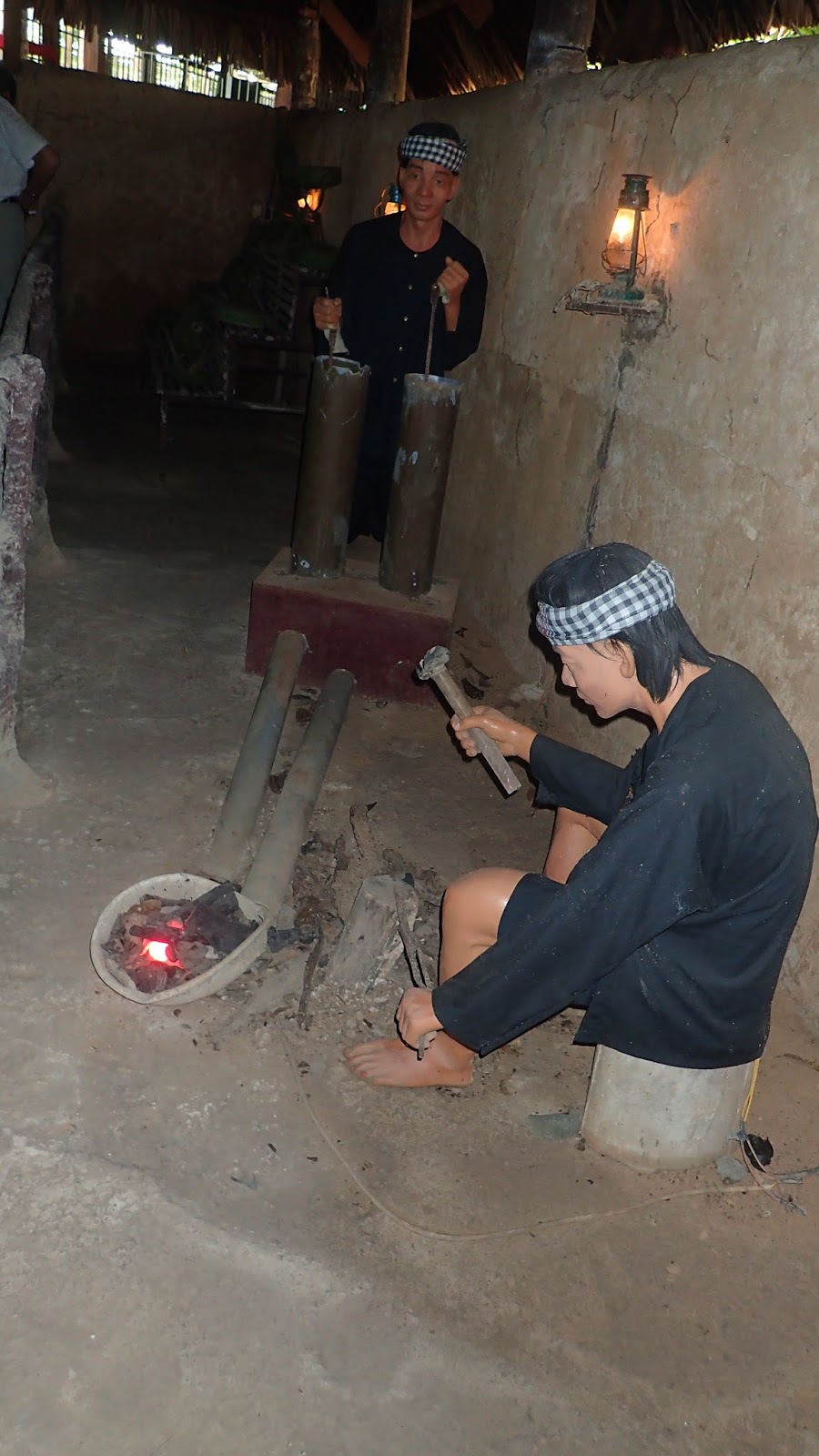
Underground bunkers were used for making clothes, shoes and even weapons.


The Viet Cong would collect the shrapnel from the allied bombs. Part of it they would melt down to make spikes for their traps, others were used to make land mines. All of this work was carried out in underground bunkers.


They made so many different types of torture traps.


Once the war was over, this area of bunkers and tunnels was used to teach the Vietnamese children about the history of the war. It has now been opened for tourism and many of the tunnels have been expanded to allow our larger frames to fit into them.  The tunnels are very hot, sweaty and dirty and the jungle is full of mosquitoes. 

Our tour of the Cu Chi tunnels was eye-opening to say the least, and really gave us insight as to what many of our soldiers encountered during that war.  It was truly a war of the super powers of the world, not just a war between North and South Vietnam. Whether you supported the war, or hated it, coming back to Vietnam is something that everyone should experience in their lives.  There is so much here that a textbook can never teach!